
2026 FIFA World Cup Betting — Australia's Insider Edge
 Available in US
Eight years in this game, and I have never seen a World Cup reshuffle the betting landscape this dramatically. A 48-team field, 104 matches crammed into 39 days across three countries, and a qualification format that hands the round of 32 to teams that finish third in their group — if you are still approaching this tournament with 32-team logic, you are already behind the market.
I built Kickvault for one reason: to give Australian punters the analytical edge that generic international tipsters cannot deliver. That means decimal odds in AUD, every kick-off converted to AEST, ACST and AWST, and a clear-eyed read on the Socceroos' Group D prospects — not the rose-tinted version you will get from broadcast pundits. It also means calling out the traps that bookmakers set for casual punters during every major tournament.
What follows is the insider overview I wish someone had handed me before my first World Cup cycle. I will walk you through the format changes that break old models, the outright odds that actually contain value right now, every group condensed into a punter-friendly snapshot, the markets most Aussies overlook, and — critically — the legal and practical realities of betting on the 2026 World Cup from Australian soil. Settle in. This is your map to the biggest football betting event in history.
The 2026 World Cup Betting Briefing You Need Before Kick-Off
- The expanded 48-team format creates 104 matches and a third-place qualification route — old tournament betting models no longer apply, and the value window is wider than any previous World Cup.
- Spain lead the outright market at around 5.50, but the real edge sits in the 9.00-to-21.00 range where second-tier contenders are mispriced against their squad depth.
- The Socceroos face a competitive but escapable Group D alongside the USA, Turkey and Paraguay — their opener against Turkey on 14 June is the swing match.
- Australian punters must navigate in-play restrictions, the credit card ban and a tightening advertising regime — knowing the rules protects your bankroll as much as knowing the odds.
- Group stage multis, draw no bet lines and top-scorer props consistently offer better expected value than outright winner bets at this stage of the market cycle.
The Cash-Out Verdict
Online in-play betting is banned in Australia, so cash-out is the only live exit you have on your phone — and the bookmaker sets the price with no competing market to keep it honest. Put your bet in below and see the exit value, what the offer actually costs you, and the price you'd need over the phone to beat it.
Your bet
The verdict
- UNDER 3%A thin toll for certainty.
- 3–8%Ordinary. Pay it if you want out.
- 8–15%Expensive. Only for real relief.
- OVER 15%You're paying the bookmaker to end your own bet.
Cash-out closes a bet you already placed and is permitted online. Placing a new bet mid-match is not — under the Interactive Gambling Act 2001 that has to go through your licensed bookmaker's phone line. Three-way markets need two hedge legs, which pushes the break-even price higher than shown. 18+. Gambling Help Online.
What Makes 2026 the Biggest World Cup Gamble Yet
I tracked every World Cup cycle since 2010, and none of them required me to rebuild my entire analytical framework from scratch. This one does. FIFA's expansion from 32 to 48 teams is not a cosmetic tweak — it fundamentally changes the probability distributions that underpin every betting market, from outright winner to group stage totals. If you have been punting World Cups using the same playbook since Russia 2018 or Qatar 2022, that playbook is now a liability.
The numbers tell the story. Twelve groups of four teams replace eight groups of four, producing 104 matches across 39 days — up from 64 matches in 29 days at the last tournament. The top two from each group advance, plus the eight best third-placed finishers, feeding into a round of 32 before the traditional knockout bracket resumes. That third-place escape route is critical for punters because it compresses the qualification threshold: a team can lose one group match, draw another, and still progress. In practical terms, roughly 53% of all competing nations will reach the knockouts. Compare that to 50% under the old format and the margin seems slim, but the psychological impact on group stage tactics is enormous. Managers will park the bus earlier, play for draws more often, and rest starters in dead rubbers knowing that a single win plus a draw could be enough.
104 matches in 39 days means an average of 2.67 games per day — punters who track every fixture will process more live data in five and a half weeks than most domestic league seasons produce in four months.

The tri-host structure adds another layer. Matches are spread across the United States (78 fixtures across 11 stadiums), Mexico (13 matches, 3 stadiums) and Canada (13 matches, 2 stadiums). The opening ceremony and first match take place at Estadio Azteca in Mexico City on 11 June 2026, where altitude — 2,240 metres above sea level — has historically wrecked visiting sides that do not acclimatise. The final lands at MetLife Stadium in East Rutherford, New Jersey on 19 July 2026, a venue that can swing between stifling summer humidity and surprise thunderstorms. Climate and travel logistics across three time zones will affect squad rotation, fatigue and form in ways that previous single-host tournaments did not test.
For Australian punters, the time zone gap is the sharpest practical change. The majority of group stage matches will kick off between 22:00 and 06:00 AEST. You are looking at late nights, early mornings and a tournament that overlaps with the AFL and NRL seasons — so your sports viewing schedule will be chaotic. Having the full schedule converted to Australian time zones is worth bookmarking before you place a single bet.
The 48-team format does not just add matches — it restructures how teams qualify, how managers rotate squads, and how odds are priced. Treating 2026 like a bigger version of 2022 is the fastest way to burn your bankroll.
From a market perspective, the expansion dilutes favourite dominance. More teams means more variance, more upsets and longer paths to the trophy. The outright winner market is inherently less predictable when a champion must win seven matches instead of the previous six. Each additional knockout round is another coin-flip moment where a penalty shootout or a red card can end a favourite's campaign. Bookmakers know this, which is why the shortest outright price in the market — Spain at roughly 5.50 — is longer than any pre-tournament favourite has been priced in over a decade. That widening of the field is not noise. It is the market telling you that certainty has left the building.
Socceroos in Group D — The Insider View
Every four years, Australia experiences the same cycle: AFL and NRL fans suddenly discover football, the Socceroos become a unifying national story, and bookmakers quietly adjust their margins on Australian-facing markets because they know the emotional money is coming. I have watched it happen in 2018 and 2022, and the pattern is already forming for 2026. The difference this time is that the Socceroos genuinely have a path — not a dream run, but a mathematically plausible route through a group that other analysts are overcomplicating.
Group D pairs Australia with the United States, Turkey and Paraguay. On paper, the USA are clear favourites — host-nation advantage, a generation of players embedded in top European leagues, and home crowds that will turn every fixture into a fortress. I am not going to pretend the Socceroos can topple the hosts. But the group is not about beating the USA. It is about finishing second, or — thanks to the expanded format — finishing third with enough points and goal difference to qualify as one of the eight best third-placed teams.
Insider Take: The opening match against Turkey on 14 June at BC Place in Vancouver is the fixture that determines Australia's tournament. A win there makes second place realistic. A loss means the Socceroos spend the remaining two matches trying to recover points against the USA and Paraguay — an ugly position.
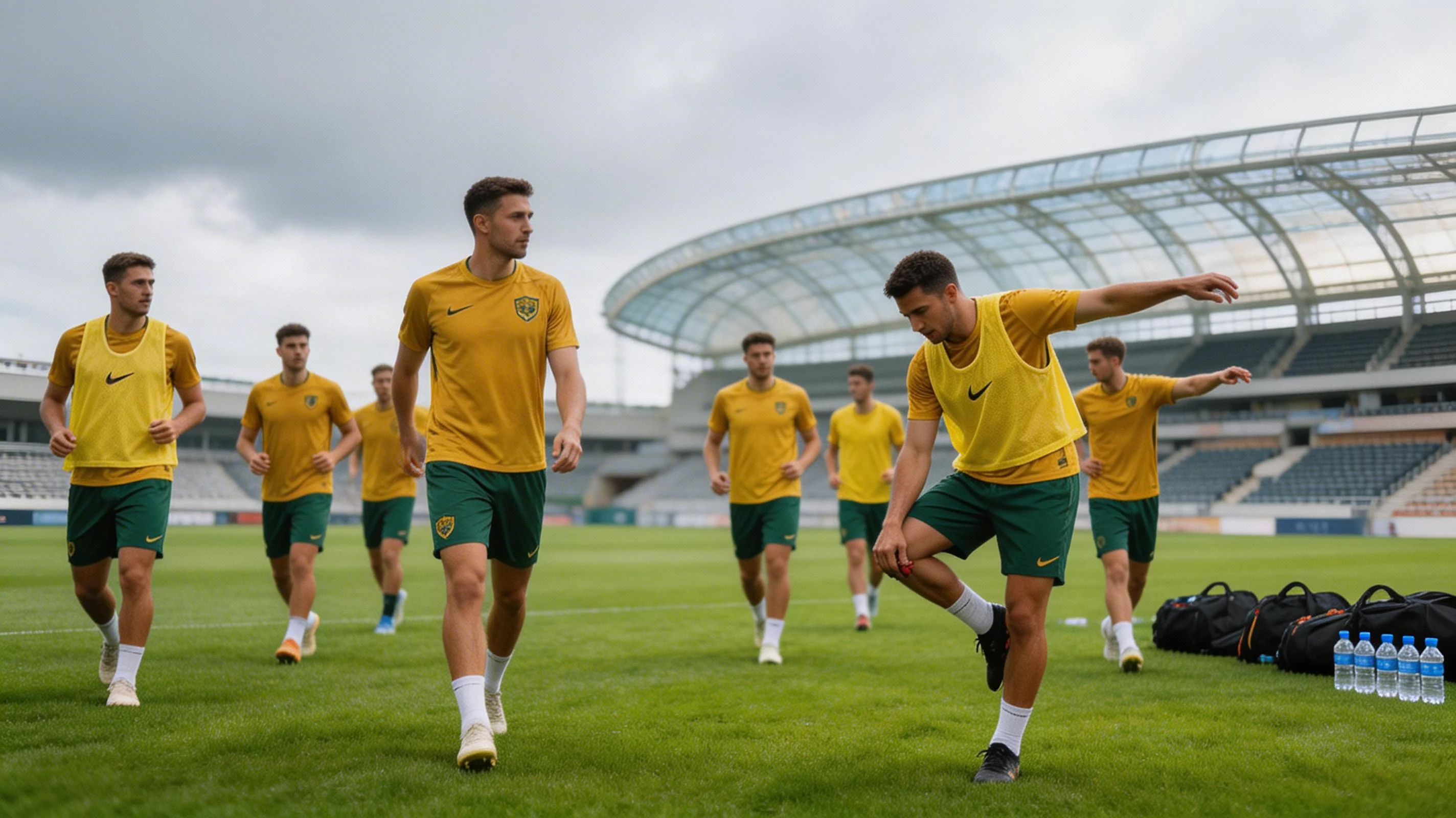
Turkey qualified through a tense playoff cycle and bring a squad rich in Süper Lig and mid-tier European league talent. They are physical, tactically disciplined under pressure, and dangerous on set pieces. But they also have a habit of underperforming at major tournaments relative to their qualifying form — a pattern I track closely because it creates consistent value on the "against" side. Paraguay are similarly unpredictable: a South American qualifier campaign that fluctuated wildly, a squad that relies heavily on a small core of experienced players, and a style that thrives on chaos. For Australia, Paraguay represent the most "winnable" fixture on paper, but the match falls on 25 June in Santa Clara — the third and final group game, where lineup rotation and permutations could produce bizarre tactical setups.
The Socceroos' schedule deserves attention beyond the opponents. The opener against Turkey kicks off at midnight ET on 14 June, which translates to 14:00 AEST — a rare afternoon slot for Australian viewers. The second match, USA vs Australia at Lumen Field in Seattle, starts at 15:00 ET on 19 June, meaning a 05:00 AEST alarm on 20 June. The closer against Paraguay at Levi's Stadium begins at 22:00 ET on 25 June, landing at 12:00 AEST on 26 June. Two of three matches fall inside reasonable Australian viewing hours, which matters because live engagement drives live betting volume — and that volume moves lines in real time.
Australia's FIFA ranking of approximately 25th places them as the third-strongest team in Group D by the numbers, but rankings undervalue the Socceroos' tournament experience — five World Cup appearances since 2006, including a Round of 16 run in 2022.
My read on the Socceroos' realistic ceiling is straightforward. They need four points from three matches to have a strong chance of progressing — either as runners-up or as a qualified third-placed side. The full Socceroos squad analysis and betting breakdown covers the player-by-player depth, but from a group dynamics standpoint, the critical variable is whether Australia can avoid defeat in the opening fixture. Every scenario I have modelled shows that an unbeaten start against Turkey lifts the Socceroos' qualification probability above 55%. A loss drops it below 30%. That single match is worth more analytical attention than the other two combined.
Opening Odds Breakdown — Where the Smart Money Is Going
I pulled outright winner odds from four major Australian-licensed bookmakers on the same morning, and the discrepancies were wide enough to drive a truck through. That is unusual this far out from a tournament — typically, outright markets converge as kick-off approaches and sharp money flattens the edges. But the 48-team format has introduced genuine uncertainty into how bookmakers model knockout paths, and that uncertainty is showing up as inconsistent pricing across the board.
Spain sit at the top of most boards, priced around 5.50 across the Australian market. They are the reigning European champions with a squad that blends peak-age stars and emerging talent at virtually every position. The implied probability at 5.50 is roughly 18%, which feels about right for a team of their calibre in a 48-team field — perhaps even slightly generous when you consider the extra knockout round they would need to navigate. England follow at approximately 6.50, a price that reflects their depth but also their well-documented tendency to stumble when expectations peak. France are hovering near 8.50, and Brazil — still searching for their first title since 2002 — sit around the same mark.
5.50 Spain's outright odds — the shortest price in the market, implying an 18% chance to lift the trophy.
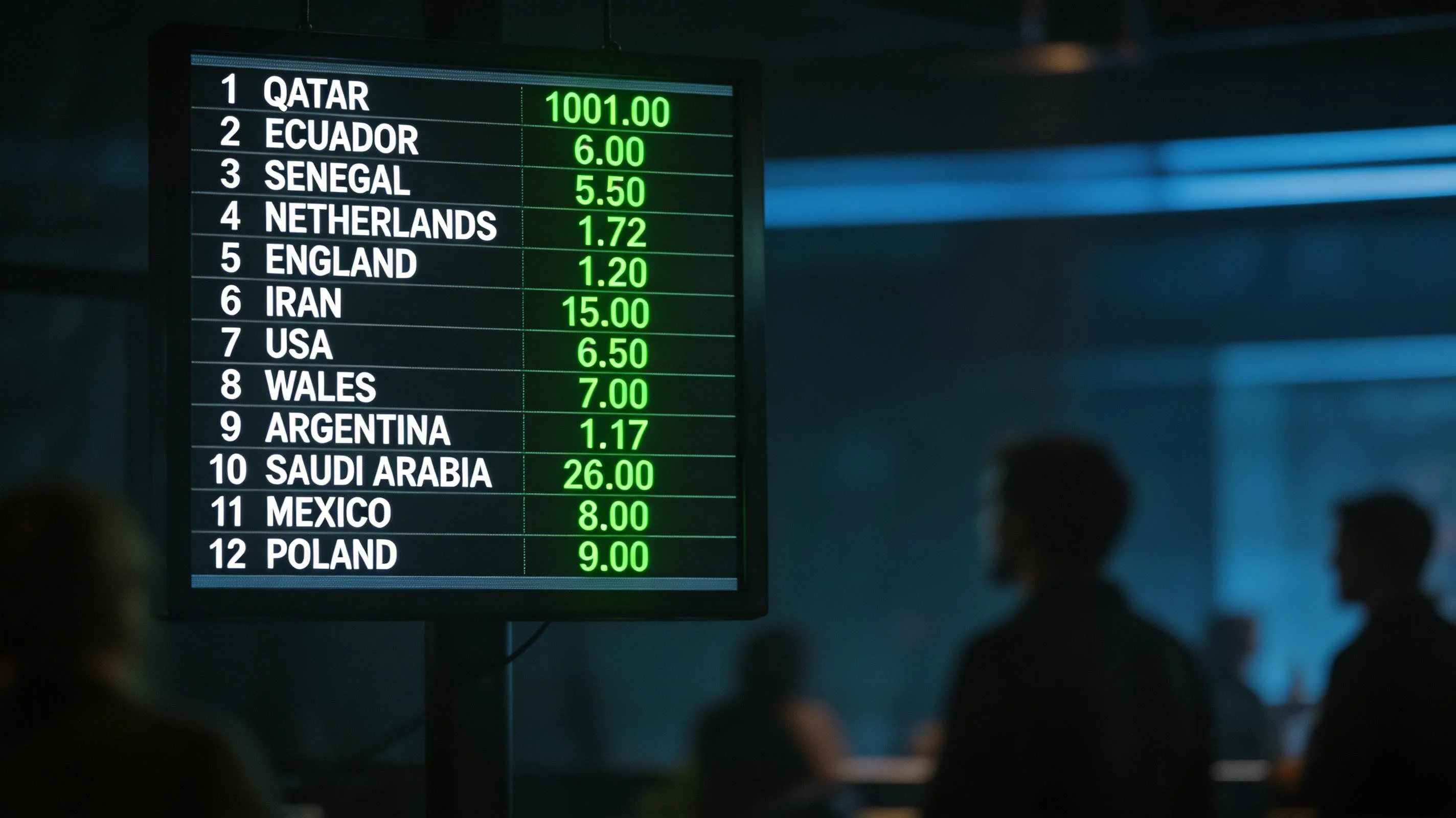
Argentina, the defending champions, are a fascinating case. Their price has drifted out to approximately 9.00 in some Australian books, driven largely by the Messi question. Whether Lionel Messi features in the squad — and if he does, how much of the 39-day tournament his body can sustain — is the single biggest variable in the outright market. I have seen sharper money move against Argentina in recent weeks, suggesting insiders expect a reduced Messi role or none at all. If you believe Argentina's system has matured beyond Messi-dependency under Lionel Scaloni, the 9.00 price offers value. If you think removing Messi guts their creative engine, it is a trap.
The mid-range — prices between 11.00 and 21.00 — is where I spend most of my analytical time. Germany at around 13.00 are attempting a rebuild after a dismal home Euros cycle. The Netherlands at roughly 15.00 bring squad depth but lack a genuine top-tier goalscorer. Portugal, navigating life after Cristiano Ronaldo's international career, sit near 17.00 with a squad that is younger and arguably more balanced than their Ronaldo-era vintage. Each of these teams has a realistic path to the semi-finals, and at these prices, you are being paid generously for a scenario that is far from improbable.
Insider Take: The full odds comparison across Australian bookmakers shows price gaps of up to 15% on the same team depending on which platform you use. Shopping lines is not optional at this tournament — it is the easiest edge available.
Further down the board, the Socceroos are priced between 81.00 and 101.00 to win the tournament outright — essentially a novelty bet that implies a sub-1.2% probability. That is not where the value lies for Australian punters backing the national team. The smarter play is in the group-specific markets: Australia to qualify from Group D (priced around 2.80 at most Australian books), Australia to finish top two in the group (around 4.50), and individual match result lines where the Socceroos are underdogs but not hopeless.
One pattern I always track at this stage of the market cycle is where the public money clusters versus where the sharp money moves. Public bettors gravitate toward name recognition — England, Brazil, Argentina — and bookmakers shade those prices accordingly, building in a "popularity tax" that erodes value. Sharp bettors, by contrast, tend to target teams with strong underlying metrics (expected goals, defensive solidity, set-piece conversion) that the public underweights. In this cycle, I am seeing sharp interest in Spain, Colombia and Turkey at their respective price points. The public is loading up on England and Brazil. That divergence is the earliest signal of where the market will move between now and June.
At this stage of the cycle, outright markets are wider and less efficient than they will be by kick-off. The edge is in identifying which prices will shorten — and getting on early — rather than trying to pick the winner outright.


Group-by-Group Quick Picks
Twelve groups is a lot of information to process, and most preview content buries you in paragraphs about every team's qualifying campaign without telling you the one thing that matters: where the betting value actually sits. I have condensed each group into the sharpest angle I see — a single pick, a danger flag, or a market I would target. The full decoded breakdown goes deeper on scenarios, permutations and match-by-match analysis, but here is the quick-fire version.
Group A — Mexico, South Korea, South Africa, Czechia
Mexico open the tournament as hosts in front of 80,000 at the Azteca, and the emotional lift from that fixture will carry them through a manageable group. South Korea are the danger side — disciplined, fast on transitions, and historically strong at World Cups. My angle: South Korea to qualify at around 1.65 is too short, but South Africa to finish bottom at 1.90 is solid. Czechia are the sleeper third-place candidate.
Group B — Canada, Switzerland, Qatar, Bosnia and Herzegovina
Switzerland are the class act here, and their price to top the group (around 2.40) is fair. Canada have home-crowd energy but an inconsistent squad that struggled through CONCACAF qualifying. Qatar, the 2022 hosts, were dire on home soil and look overmatched against European opposition. Bosnia bring flair but lack tournament pedigree. My pick: Switzerland to top, Canada to qualify second.
Group C — Brazil, Morocco, Haiti, Scotland
Brazil are expected to cruise, but Morocco — the 2022 semi-finalists — make this group deceptively tricky. Haiti are genuine debutants with little chance of progressing, and Scotland's World Cup record is historically painful. The value angle here is Morocco to beat Brazil in their head-to-head fixture. Morocco have the defensive structure and set-piece quality to frustrate Brazil, and the head-to-head price (around 4.50 at early markets) underestimates that matchup.
Group D — USA, Paraguay, Australia, Turkey
Covered in detail above and in the dedicated Group D preview. The USA will top this group. The fight for second is between Australia and Turkey, with Paraguay capable of spoiling both. My lean: Australia to qualify, Turkey to finish third but still progress via the best third-place route.
Group E — Germany, Côte d'Ivoire, Ecuador, Curaçao
Germany need a statement tournament after their home Euros disappointment, and Group E gives them the platform. Côte d'Ivoire, the reigning AFCON champions, are the value play — their price to qualify (around 2.10) underrates a squad that peaks for tournament football. Ecuador are dangerous opponents for anyone but lack consistency. Curaçao are debutants and heavy underdogs in every fixture.
Group F — Netherlands, Japan, Tunisia, Sweden
This is a group where every match could go either way. Japan are Asia's strongest representative and have eliminated Germany and Spain in recent World Cup group stages. The Netherlands have the squad depth but a coaching setup that has drawn criticism. Tunisia are physical and well-organised. Sweden are rebuilding after a generational transition. My angle: Japan to top the group at 3.50 is the standout value bet in the entire group stage.
Group G — Belgium, Iran, New Zealand, Egypt
Belgium's golden generation is fading, and this squad is weaker than any they have sent to a World Cup since 2014. Egypt — with Mohamed Salah likely in his final major tournament — have the star power to cause an upset. New Zealand are competitive underdogs. Iran are tactically disciplined. My pick: Egypt to qualify at around 3.00 is worth a look.
Group H — Spain, Saudi Arabia, Cape Verde, Uruguay
Spain will dominate this group, but Uruguay make it interesting. The two should qualify comfortably, though Saudi Arabia — after their famous win over Argentina in 2022 — cannot be dismissed entirely. Cape Verde are debutants. The betting angle is Spain to win all three group matches, priced around 3.20 in some Australian books.
Group I — France, Senegal, Iraq, Norway
France are the obvious group winners, but Senegal — Africa's strongest side alongside Morocco — will push them hard. Iraq are a rising force in Asian football and could surprise. Norway, with Erling Haaland, have the individual quality to trouble anyone on their day. My angle: Senegal to qualify at 1.85 is nearly free money. This is a two-horse group between France and Senegal with the others scrapping for third.
Group J — Argentina, Algeria, Austria, Jordan
Argentina should progress without drama, though their form without Messi remains an open question. Algeria have a hungry squad with European-based players pushing for breakout performances. Austria are methodical and well-coached. Jordan are debutants. The value pick: Algeria to finish second at around 3.80.
Group K — Portugal, DR Congo, Uzbekistan, Colombia
Colombia are the underpriced threat in this group. Their squad is stacked with Premier League and La Liga talent, and they qualified from the brutal South American section. Portugal are the favourites, but Colombia to top the group at roughly 3.50 is my preferred angle. DR Congo have the athleticism to trouble teams, and Uzbekistan are debutants who will compete hard but lack the quality to progress.
Group L — England, Croatia, Ghana, Panama
The most narratively loaded group in the draw. England and Croatia have unfinished World Cup business stretching back to 2018, and their head-to-head will likely determine the group winner. Ghana bring pace and unpredictability. Panama are back after their debut in 2018 but face a steep challenge. My pick: Croatia to beat England in their direct meeting at around 4.20 — a price that undervalues Croatia's big-tournament composure.
Group stage betting rewards specificity. Instead of backing outright winners, target individual group markets — group winner, team to qualify, head-to-head results — where the pricing is less efficient and your analysis has the sharpest edge.






Markets That Matter — Beyond the Outright Winner
The outright winner market gets 80% of the public attention and roughly 40% of the total handle at any World Cup. That ratio should tell you something: the market where the most eyeballs land is also the market where bookmakers build their fattest margins. I have seen Australian punters throw hundreds of dollars at England or Brazil futures without ever glancing at the markets that consistently deliver better expected value across a tournament cycle.
Group stage match betting is my bread and butter during the first two weeks. With 48 group matches completed before the knockout rounds begin, you get a deep pool of fixtures where information asymmetry is highest — bookmakers set early lines based on FIFA rankings and historical data, but squad announcements, injury news and tactical setups in the days before each match can shift the true probability significantly. The head-to-head market (1X2) is the simplest entry point. Draw no bet removes the dead-heat risk for a slightly shorter price and is particularly useful in group matches where both teams may be content with a point.
Draw No Bet — a market where your stake is refunded if the match ends in a draw. You only win or lose based on which team wins outright, removing the draw as a losing outcome.
Asian handicap lines open up a more nuanced approach. In a match like USA vs Australia, where the hosts might be priced at 1.55 on the head-to-head, a -1.0 Asian handicap on the USA at around 2.10 gives you a better payout if you believe they will win by two or more goals, with a refund if they win by exactly one. These lines are sharper — meaning the margin is thinner — because they attract professional money, and that thinner margin works in the punter's favour over a high volume of bets.
Tournament specials are where I find the most overlooked value. Top goalscorer (Golden Boot), best young player, furthest-progressing debutant, and total tournament goals are all markets that Australian bookmakers offer with varying degrees of sophistication. The Golden Boot market in particular is historically mispriced because the public piles onto the biggest names — Mbappé, Haaland, Harry Kane — while the actual winner is often a striker from a team that plays more group stage minutes due to comfortable qualification. Across the last five World Cups, only one Golden Boot winner was the pre-tournament favourite. That is a pattern worth building a strategy around.
Multis — the Australian punter's favourite weapon and, too often, their downfall. A multi (parlay) combines multiple selections into a single bet at compounded odds. The appeal is obvious: turning a $10 stake into a $500 return feels electric. The mathematical reality is less flattering. Each leg you add multiplies the bookmaker's margin along with the odds, and by the time you have strung together four or five group stage results, the overround embedded in your multi can exceed 25%. I am not saying avoid multis entirely — I use them selectively for correlated outcomes, such as two heavy favourites in the same time slot both winning to nil — but the deeper breakdown of World Cup betting types will show you when multis make sense and when they are just donating margin to the bookmaker.
Insider Take: In-play betting on World Cup matches is legal in Australia only by telephone. If you want to back a live position during a match, you must call your bookmaker's phone line. Online in-play wagering is prohibited under the Interactive Gambling Act. Plan accordingly — pre-match positions and cash-out options are your primary tools for managing live exposure.
Hidden Value: 5 Bets the Public Is Missing
Every analyst publishes a "best bets" list before a World Cup, and most of them converge on the same obvious picks. I am not interested in obvious. I am interested in where the market has left a gap — a price that does not reflect the underlying probability because the public is looking somewhere else. These five angles are not guaranteed winners. Nothing is. But each one represents a scenario where I believe the odds are offering more than they should.
1. Colombia to reach the quarter-finals at around 4.00. Colombia qualified from CONMEBOL — the hardest confederation — and their squad features players at peak age across Europe's top five leagues. They are in Group K alongside Portugal, DR Congo and Uzbekistan. Second place behind Portugal is the most likely outcome, feeding them into a round of 32 fixture against a group winner from a weaker section. The quarter-final path is shorter than the price implies, and I would back this at anything above 3.50.
2. Under 2.5 total goals in the final at around 1.85. World Cup finals are tense, cagey, low-scoring affairs. Five of the last seven finals produced two or fewer goals in regular time. The expanded format means the finalists will have played seven matches over 39 days to reach MetLife Stadium — fatigue, tactical conservatism and the sheer weight of occasion all push toward a tight match. This is a structural bet, not a team-specific one, and structural bets are my favourite kind because they do not depend on who reaches the final.
3. A debutant to win at least one group stage match at around 1.50. Five nations — Haiti, Curaçao, Cape Verde, Uzbekistan and Jordan — are making their first World Cup appearance. History shows that debutants are frequently underestimated in at least one group fixture. Costa Rica won their group in 2014. Iceland drew with Argentina in 2018. The 1.50 price implies a 67% probability, and I would set the true probability closer to 80% given the expanded field and the quality gap between some debutants and their non-debutant group opponents.
At the 2022 World Cup, Saudi Arabia beat Argentina, Japan beat Germany, and South Korea beat Portugal in the group stage — three results that collapsed hundreds of outright multis in a single matchday.
4. Turkey to qualify from Group D at around 2.50. This is a contrarian play that directly affects the Socceroos' prospects, and I am comfortable holding both sides of the Group D argument. Turkey's squad is deeper than their FIFA ranking suggests, and their playoff qualification path — navigating Hungary and Ukraine — demonstrated resilience under pressure. At 2.50, the implied probability is 40%, which feels low for a team that realistically needs only four points to progress. I would set their true qualification probability at closer to 50%.
5. Total tournament goals over 165.5 at around 1.90. The old 64-match format produced averages between 2.4 and 2.7 goals per match across recent tournaments. At 104 matches, even a conservative 2.5 average yields 260 goals — well clear of the 165.5 line. The bookmakers are pricing this line to account for the possibility that the expanded field produces more defensive, low-quality fixtures in the group stage. I disagree. More mismatches between elite sides and debutants will inflate the goal tally, not suppress it. The over is my highest-confidence structural bet for the entire tournament.
Value betting is not about predicting outcomes — it is about identifying prices where the market's implied probability is lower than your assessed probability. These five angles each clear that threshold by a margin I am comfortable backing with real money.




What Every Aussie Punter Needs to Know for 2026
I had a mate in 2022 who placed a $200 multi on his phone during a live World Cup match, not realising that what he did was technically illegal under Australian law. His bet went through because his offshore account was not geo-blocked at the time, but he was betting on an unlicensed platform and had zero consumer protection. That conversation — and the confusion it revealed — is exactly why this section exists.
The legal framework for sports betting in Australia is clear but specific. The Interactive Gambling Act 2001, updated significantly in 2016 and again through regulatory refinements since, permits online sports betting only through operators licensed by an Australian state or territory authority. The Northern Territory Racing and Wagering Commission issues most of the online licences, but the Australian Communications and Media Authority (ACMA) enforces compliance at the federal level and actively blocks unlicensed offshore sites. If the bookmaker you are using does not hold an Australian licence, your funds are not protected, your bets are not regulated, and you may be contributing to an operation that ACMA is in the process of shutting down.
Several practical rules shape how Australians can bet on the 2026 World Cup. Online in-play wagering is prohibited — if you want to place a live bet during a match, you must do so by telephone through your licensed bookmaker. This restriction has been in place since the 2016 amendments and is unlikely to change before the tournament. Pre-match bets placed online remain legal up until kick-off, and most Australian-licensed platforms offer cash-out functionality that allows you to close a position during a live match without placing a new in-play wager. Understanding the distinction between placing a new in-play bet (banned online) and using a cash-out feature on an existing bet (permitted) is essential for managing your positions during the tournament.
Since June 2024, using a credit card to fund online betting accounts is banned in Australia. Deposits must come from debit cards, bank transfers, or approved e-wallets. This regulation applies to all licensed operators.
The advertising environment is also shifting. From 1 January 2027, gambling advertising during live sports broadcasts between 06:00 and 20:30 will be fully banned, with volume restrictions already tightening. For punters, this means you will see less promotional noise around the 2026 World Cup than at previous tournaments — fewer bonus offers splashed across broadcast coverage, fewer celebrity endorsements, and fewer push notifications designed to trigger impulsive bets. That is a net positive for disciplined punters. Less noise means fewer emotional triggers and more space for analytical decision-making.
Bankroll discipline across a 39-day tournament is the single most underrated skill in World Cup betting. I use a flat-staking model — consistent unit sizes regardless of confidence level — with a total tournament bankroll that I am prepared to lose entirely without financial stress. My World Cup bankroll blueprint walks through the unit sizing and phase-adjustment approach I use personally. The credit card ban, whatever your view on its policy merits, functions as a useful guardrail: once your deposited bankroll is gone, you cannot chase losses with borrowed money. That enforced boundary is something I would recommend even if the law did not require it.
World Cup 2026 Betting — Frequently Asked Questions
When does the 2026 World Cup start and finish?
The tournament opens on 11 June 2026 with Mexico vs South Africa at Estadio Azteca in Mexico City, and the final takes place on 19 July 2026 at MetLife Stadium in East Rutherford, New Jersey. The group stage runs for approximately two and a half weeks before the knockout rounds begin with the round of 32.
Is it legal to bet on the World Cup online in Australia?
Yes, provided you use a bookmaker licensed by an Australian state or territory authority. Unlicensed offshore platforms are illegal, and ACMA actively blocks access to them. Online in-play betting is banned — live bets during a match can only be placed by telephone. Pre-match online wagering is fully legal with licensed operators.
What odds format do Australian bookmakers use for the World Cup?
Australian bookmakers display decimal odds as standard. A price of 5.50 means a $10 bet returns $55 (including your original stake) if it wins. The implied probability of decimal odds is calculated by dividing 1 by the odds — so 5.50 implies an 18.2% probability. If you are comparing with overseas sources, many will quote fractional or American odds, but all Australian-licensed platforms default to decimal.
How many teams qualify from each World Cup 2026 group?
The top two teams from each of the twelve groups advance directly to the round of 32. In addition, the eight best third-placed teams across all groups also qualify. This means 32 of the 48 teams progress beyond the group stage — roughly two-thirds of the field — making group elimination harder than under the old 32-team format.
What time will World Cup matches kick off in Australian time?
Most group stage matches will kick off between 22:00 and 06:00 AEST due to the time zone difference with North America. AEST is 14 hours ahead of US Eastern Time during the tournament window. Some fixtures will land in more viewer-friendly windows for Australia — the Socceroos' opener against Turkey, for example, starts at 14:00 AEST on 14 June.
Can I use a credit card to fund my World Cup bets?
No. Since June 2024, Australian regulations prohibit the use of credit cards for online gambling deposits. You can fund your account via debit card, direct bank transfer, or approved e-wallet services. This applies to all licensed Australian bookmakers without exception.
What are the Socceroos' chances of progressing from Group D?
Group D includes the USA (hosts and favourites), Turkey, Paraguay and Australia. The Socceroos are realistically competing for second or third place. With the best eight third-placed teams also qualifying for the round of 32, Australia's path to the knockouts is plausible — most models give them between a 40% and 55% probability of advancing, depending heavily on the result of their opening match against Turkey.
Your 2026 World Cup Betting Starts Here — Not at Kick-Off
The best time to position yourself for the 2026 World Cup is not the week before the opening match. It is now — while outright odds are still wide, group markets are still inefficient, and the public has not yet flooded in with emotional money that compresses value across every board. I have laid out the structural changes that make this tournament different, flagged the groups and markets where I see genuine edge, and walked through the Australian-specific rules that will shape how you bet over 39 days.
What comes next is depth. The full 2026 World Cup betting guide breaks down strategy, bankroll management and market selection in detail. The team pages cover every contender from Spain to the Socceroos with squad analysis and odds assessments tailored for Australian punters. And the group previews give you the match-by-match intelligence that generic international content does not bother to localise.
This is the biggest World Cup betting event ever staged. 104 matches, 48 teams, and a format that nobody — bookmakers included — has a complete model for yet. That uncertainty is not a problem. For punters who do the work, it is the edge.
