
Estadio Azteca — The Iconic Opening Venue of the 2026 World Cup
 Available in US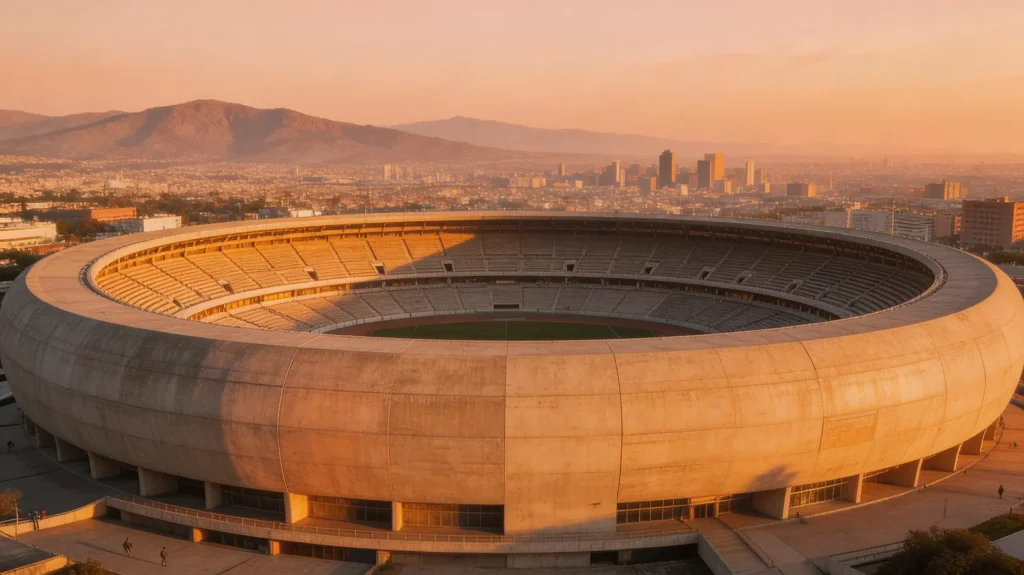
Table of Contents
No stadium on Earth has hosted more World Cup history than Estadio Azteca. Two World Cup finals — 1970 and 1986 — were decided on this pitch. Diego Maradona scored the “Hand of God” and the “Goal of the Century” in the same match here. Pelé lifted the trophy here. When FIFA announced that Estadio Azteca would host the opening match of the 2026 World Cup — Mexico versus South Africa on 11 June — they were not just selecting a venue. They were making a statement about the tournament’s ambition. The 2026 World Cup begins where World Cup magic has always been loudest.
About Estadio Azteca
The stadium was built in 1966 and has been renovated multiple times since, most recently ahead of the 2026 tournament. Its current capacity sits around 83,000, though the World Cup configuration may adjust that figure slightly depending on FIFA’s seating and media requirements. Azteca is an open-air bowl design — steep, towering stands that create an amphitheatre effect and trap noise in a way that modern stadiums with their corporate boxes and wide concourses rarely replicate. When Azteca is full and the crowd is engaged, the sound is physical. You feel it in your chest before you hear it in your ears.
The playing surface is natural grass, maintained year-round by a dedicated groundskeeping team. Unlike MetLife and other US venues that will install temporary grass over artificial turf, Azteca’s pitch is permanent and familiar. Mexican league matches are played here regularly, which means the surface will be in consistent condition — no surprises, no soft patches, no uneven bounce. For the opening match, the pitch will be in its best state of the tournament, freshly prepared and untouched by prior World Cup fixtures. That matters for punters assessing match-level bets: the surface at Azteca favours technical, possession-based football over physical, direct play.
The location within Mexico City places Azteca in the southern district of Coyoacán, surrounded by residential neighbourhoods and accessible by metro. For the tens of thousands of travelling fans expected for the opening match, the integration with Mexico City’s public transport is a significant advantage over suburban US venues. The city itself — a megapolis of twenty-two million people — will amplify the tournament atmosphere in ways that purpose-built event destinations cannot. Restaurants, bars, public plazas and fan zones will turn the opening week into a citywide festival, and that energy feeds directly into the stadium experience.
2026 Matches at Azteca
Estadio Azteca is confirmed to host the opening match — Mexico versus South Africa on 11 June — along with additional group-stage fixtures. Mexico City is one of three Mexican host cities alongside Monterrey and Guadalajara, and Azteca’s status as the country’s most famous venue means it will attract the highest-profile fixtures allocated to Mexico.
The opening match carries a specific weight in betting markets. Tournament openers are historically cautious affairs — the host nation does not want to lose on day one, and the opponent recognises the value of a point against the hosts in a group where every result matters. Since 1998, World Cup opening matches have produced an average of 2.1 goals, and the host nation has won four of the last seven openers while drawing twice. Mexico at Azteca, buoyed by a crowd that treats the national team as a matter of personal identity, will be overwhelming favourites to win the opening fixture. The question is not whether Mexico will try to win — it is whether the occasion suppresses the football to the point where a tight, low-scoring result is the likeliest outcome.
Beyond the opener, Azteca’s group-stage allocation will likely include at least one other Group A match and potentially fixtures from adjacent groups. Each match adds wear to the pitch, but Azteca’s groundskeeping infrastructure is among the best in the world — this is a stadium accustomed to hosting matches every week, not a venue scrambling to prepare a temporary surface. The pitch quality will hold throughout the group stage, which removes one variable from the betting equation for matches played here.
A Three-Time World Cup Venue — History Matters
When I mention Azteca’s history to younger analysts, they shrug. Ancient history does not move markets, they say. I disagree — and here is why. Azteca in 2026 will be the first stadium ever to host World Cup matches in three separate tournaments: 1970, 1986 and 2026. That historical weight creates an atmosphere that transcends the ninety minutes of football. Players know they are walking onto sacred ground. Managers reference the ghosts of previous tournaments in pre-match briefings. The crowd understands that they are part of a continuum stretching back over half a century. None of this shows up in an expected-goals model, but it shapes how teams approach matches at this venue.
The 1970 World Cup final at Azteca saw Brazil dismantle Italy 4-1 in one of the greatest performances in tournament history. The 1986 quarter-final between Argentina and England — Maradona’s two goals, one infamous and one immortal — is the most replayed World Cup match ever broadcast. These moments are woven into the stadium’s identity, and the Mexican public treats Azteca with a reverence that borders on religious. For the 2026 opener, that reverence translates into a crowd that will be ferociously supportive of Mexico and intimidating for South Africa. The decibel level during the Mexican national anthem alone will be a factor that no amount of scouting video can prepare an opponent for.
For punters, history offers one concrete data point: home teams at Azteca in World Cup matches have never lost. Mexico won all three group matches at Azteca in 1970 and 1986, and the semi-final and final results at the venue favoured the side with majority crowd support. That record is small-sample and should not be treated as predictive on its own, but it aligns with the broader principle that home advantage at World Cups is worth between 0.3 and 0.5 goals per match in expected-goals terms. At Azteca, I would push that figure to the upper end — 0.5 goals — because the crowd is louder, closer and more involved than at most modern venues.
The Altitude Factor — Betting Implications
Here is the detail that most preview articles bury at the bottom, and it is the one that matters most for match-level betting. Estadio Azteca sits at 2,200 metres above sea level. Mexico City’s altitude is not Everest, but it is high enough to affect athletic performance in measurable ways — particularly for teams that have not acclimatised.
At 2,200 metres, the air contains roughly 20% less oxygen than at sea level. For professional athletes performing at high intensity, this translates to earlier onset of fatigue, slower recovery between sprints, and a noticeable decline in work rate during the final twenty minutes of a match. Teams based at sea level — which includes the vast majority of World Cup squads — will feel the altitude from the sixtieth minute onward unless they have spent at least a week acclimatising in the city beforehand. South Africa, Mexico’s opening-match opponent, play domestic football at varying altitudes, with several stadiums above 1,500 metres, which gives them a partial natural advantage. But partial is not full, and the difference between 1,500 and 2,200 metres is significant.
The altitude also affects the ball. At higher elevation, reduced air resistance means the ball travels faster and with less drag, which alters the flight of long passes, crosses and shots. Goalkeepers accustomed to sea-level ball behaviour may misjudge the trajectory of shots that swerve less and arrive quicker than expected. Free kicks from twenty-five to thirty metres — a range where keepers rely on reading the ball’s flight — become marginally more dangerous at altitude. The total goals market at Azteca could tilt towards overs if set pieces and long-range efforts produce goals that would not occur at sea-level venues.
For my betting approach to Azteca matches, I adjust two variables: I increase the probability of late goals by roughly five percentage points (reflecting altitude-induced fatigue) and I increase the probability of goals from outside the box by a smaller margin. These adjustments are not dramatic, but they compound across multiple matches at the venue and create small edges in the total goals and goal-timing markets that more casual punters overlook.
Insider Take
Estadio Azteca is not just a venue — it is a competitive advantage for whoever plays there with the crowd behind them. The altitude, the noise, the history and the pitch quality combine to create conditions that are genuinely unique in world football. For the opening match, Mexico will be the beneficiary, and I expect them to win by at least one goal in a match that finishes 2-0 or 2-1.
The sharper bet, though, is not on the opening match result — it is on the structural properties of Azteca that apply to every match played there. Late goals, set-piece goals, and the group-stage dynamics that unfold when fatigued teams make mistakes in the final quarter of the match — these are the patterns that Azteca amplifies. Build them into your match-level models for every fixture at this venue, and the cumulative edge across the group stage is worth more than any single bet on the opener.
