
World Cup 2026 Schedule in Australian Time — AEST, ACST, AWST
 Available in US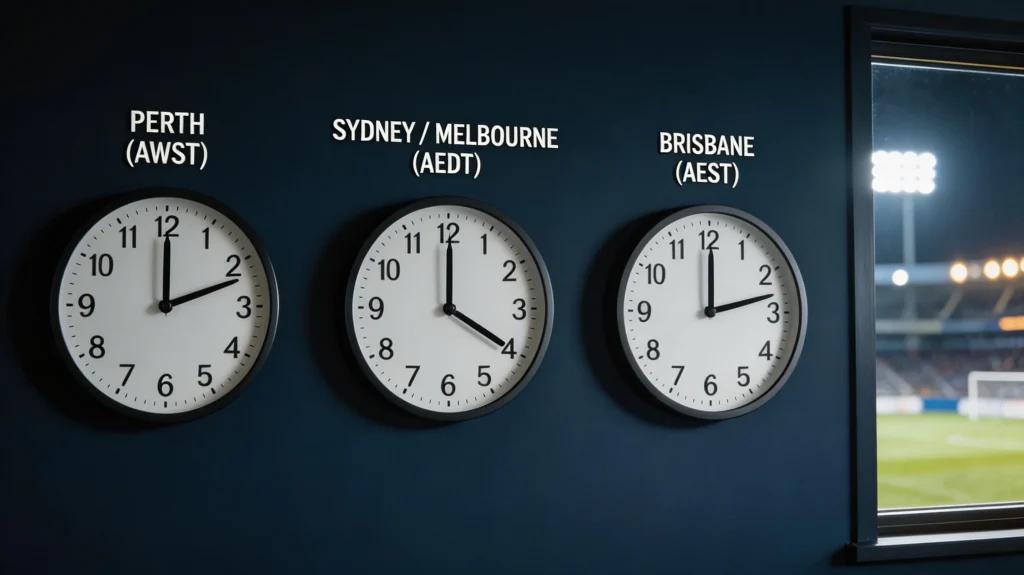
Table of Contents
At the 2022 World Cup in Qatar, Australians had it easy. Kickoff times landed in the evening and late at night — civilised hours for a country used to staying up for sport. The 2026 World Cup is a different beast entirely. With matches spread across the USA, Mexico, and Canada, the bulk of kickoff times translate to early morning and pre-dawn hours in Australia. The Socceroos’ second group match against the USA kicks off at 5:00 AM AEST on a Friday. If you are planning to watch — or bet — on the 2026 World Cup from Australia, you need a schedule that works in your time zone, not theirs.
I have converted the key fixtures into AEST, ACST, and AWST so you can plan your viewing, your alarm clocks, and — most importantly — your betting windows around the reality of Australian life during a North American tournament.
Understanding the Time Difference
The 2026 World Cup is hosted across three North American time zones: Eastern Time (ET), Central Time (CT), and Pacific Time (PT). Matches in New York, Miami, Atlanta, Philadelphia, and Boston kick off in ET. Matches in Houston, Kansas City, Dallas, and Mexico City kick off in CT. Matches in Los Angeles, Seattle, San Francisco, and Vancouver kick off in PT. The time gaps to Australia are brutal.
AEST — Australian Eastern Standard Time, covering Sydney, Melbourne, Brisbane, Canberra, and Hobart — runs UTC+10. During the World Cup (June-July), North America is on daylight saving time, putting ET at UTC-4. That is a 14-hour gap. A match kicking off at 1:00 PM ET is 3:00 AM the next day in Sydney. A 9:00 PM ET kickoff — common for marquee evening matches in the USA — translates to 11:00 AM the following day AEST. The evening ET slots are the ones that work best for Australian viewers and punters.
ACST — Australian Central Standard Time, covering Adelaide and Darwin — runs UTC+9:30. Subtract 30 minutes from every AEST time. A 5:00 AM AEST kickoff is 4:30 AM ACST. The half-hour difference matters less than you might think during normal waking hours but can be the difference between a tolerable alarm and an absurd one at the margins.
AWST — Australian Western Standard Time, covering Perth — runs UTC+8. Subtract two hours from AEST. That 5:00 AM AEST match becomes 3:00 AM in Perth. Western Australians have it worst for the early-morning kickoffs, but the trade-off is that late ET matches — 10:00 PM ET, which is 12:00 PM AEST — convert to 10:00 AM AWST, landing squarely in the workday morning. Perth-based punters will find the late ET and PT kickoffs most accessible.
The Mexico City matches add another wrinkle. CT is one hour behind ET, so a 12:00 PM CT kickoff at Estadio Azteca is 1:00 PM ET, which converts to 3:00 AM AEST. The opening match — Mexico vs South Africa on 11 June — kicks off at a time that will land somewhere around 2:00-4:00 AM for most Australians, depending on the exact schedule release. If you want to watch the opening ceremony and first match, set two alarms.
Socceroos Schedule in All Australian Time Zones
These are the three matches that matter most to every Australian punter. I have converted them from ET to all three Australian time zones so there is no ambiguity.
The first match is Australia vs Turkey on Saturday 14 June (Australian date) at BC Place in Vancouver. The ET kickoff is midnight (technically 12:00 AM on 14 June ET, which is late Friday night in North America). In AEST, that converts to 2:00 PM Saturday — the best possible timeslot for Australian viewers. A Saturday afternoon Socceroos match at the World Cup is a gift. In ACST it is 1:30 PM Saturday, and in AWST it is 12:00 PM Saturday. This is the match where Australia’s World Cup begins, and the timing means maximum viewership and maximum betting activity from Australian punters. Expect the local bookmakers to run their biggest promotions around this fixture.
The second match is USA vs Australia on Friday 20 June (Australian date) at Lumen Field in Seattle. The ET kickoff is 3:00 PM, which converts to 5:00 AM AEST on the following day — Saturday 21 June in Australia. Wait, let me correct that: 3:00 PM ET on Friday 20 June is 5:00 AM AEST on Saturday 21 June. In ACST it is 4:30 AM Saturday. In AWST it is 3:00 AM Saturday. This is the brutal one. A 5:00 AM alarm on a Saturday morning is achievable for dedicated fans, but it is not casual viewing. For punters, the pre-match betting window closes even earlier — you need your bets placed by 4:30 AM AEST at the latest if you are using in-play by phone once the match starts.
The third match is Paraguay vs Australia on Thursday 26 June (Australian date) at Levi’s Stadium in Santa Clara. The ET kickoff is 10:00 PM, which converts to 12:00 PM AEST on Friday 27 June. In ACST it is 11:30 AM Friday, and in AWST it is 10:00 AM Friday. This is another workday lunchtime slot for eastern Australia — not ideal for watching live at the office, but manageable for checking scores and placing pre-match bets during a lunch break. This match could determine whether Australia qualify for the knockout stage, so expect sick days to spike across the country.
Key Matches — When to Set Your Alarm
Beyond the Socceroos fixtures, the 2026 World Cup features marquee matches throughout the group stage and knockout rounds that Australian punters will want to watch and bet on. Here are the timeslot patterns to plan around.
Group stage matches in the USA will typically kick off at three or four different times each matchday: a morning slot (around 11:00 AM-1:00 PM ET), an afternoon slot (3:00-4:00 PM ET), an evening slot (6:00-7:00 PM ET), and a late slot (9:00-10:00 PM ET). For Australian punters, the late ET slot is the golden window — 9:00 PM ET converts to 11:00 AM AEST, which is mid-morning on the following day. The evening ET slot (6:00 PM ET = 8:00 AM AEST) is also accessible for early risers. The morning and afternoon ET slots, however, translate to 1:00 AM to 6:00 AM AEST — sleep-destroying territory.
The knockout rounds consolidate into fewer, later kickoff times. Round of 32 and Round of 16 matches are typically scheduled at prime-time ET slots — 4:00 PM, 6:00 PM, or 8:00 PM ET — which means 6:00 AM, 8:00 AM, or 10:00 AM AEST. The quarter-finals, semi-finals, and final will almost certainly kick off in the evening ET window, converting to late morning or midday AEST. The World Cup Final at MetLife Stadium on 19 July is expected to kick off around 4:00-5:00 PM ET, which would be 6:00-7:00 AM AEST on a Sunday morning — early but entirely doable for the biggest match of the tournament.
Group D matches — the ones involving Australia’s opponents — are worth tracking separately. USA vs Turkey, USA vs Paraguay, Turkey vs Paraguay — these matches determine the group dynamics that affect the Socceroos’ qualification chances. Watching or at least following these fixtures gives you information for your Australia-related bets that purely looking at the Socceroos’ own matches does not provide. If Turkey lose to the USA in their first match and then face Australia needing a result, that changes the match profile entirely.
Best Betting Windows for Aussies
Pre-match betting is straightforward — you can place your bets at any time before kickoff, so the time zone issue only matters if you want to review late team news or odds movements before the match starts. Most bookmakers publish confirmed lineups roughly 60-90 minutes before kickoff. For a 5:00 AM AEST match, that means lineup news drops around 3:30-4:00 AM. If lineup information is critical to your bet — and it should be, especially for prop markets and Asian Handicaps — you either need to wake up early or place your bet the night before and accept the risk of missing a late change.
In-play betting by phone, which is the only legal option in Australia, is most practical during AEST daytime hours. Matches kicking off between 8:00 AM and 12:00 PM AEST are the sweet spot for Australian in-play punters — you are awake, alert, and able to call your bookmaker without the impaired judgment that comes with a 3:00 AM alarm. During the group stage, I recommend identifying two to three matches per week that fall in this window and preparing your in-play strategy in advance. Having a specific scenario in mind — “if Team X concedes first in the first half, I will call and back them on the Asian Handicap” — removes the need for on-the-spot decision making at unsociable hours.
The late-night and early-morning matches (1:00-5:00 AM AEST) are better suited to pre-match betting only. Place your bets before bed, set a silent alarm to check the result when you wake up, and resist the temptation to stay awake watching every group match. The 2026 World Cup runs 39 days. If you sacrifice sleep for the group stage, you will be physically and mentally depleted by the knockout rounds — which is precisely when the best betting opportunities emerge. Treat the group stage as a marathon, not a sprint. Save your late nights and early alarms for the Socceroos matches and the quarter-finals onward.
Planning Your Tournament Around Australian Life
The reality for most Australian punters is that the 2026 World Cup will coexist with work, family, and the Australian winter. June and July in Australia mean short days, cold mornings, and the middle of the AFL and NRL seasons competing for attention. The World Cup does not exist in a vacuum — it has to fit into your life, not the other way around.
My planning approach is to identify three tiers of matches. Tier one: must-watch live. These are the Socceroos’ three group matches, any knockout match involving Australia, and the semi-finals and final. I block these in my calendar, set alarms, and adjust my schedule around them. Tier two: watch if convenient. These are the major group stage clashes (France vs Senegal, Netherlands vs Japan, England vs Croatia) and the quarter-finals. I watch these live if the timing works, or catch extended highlights within a few hours. Tier three: bet pre-match, check results later. These are the remaining group matches and early knockout rounds where I have a betting interest but no emotional investment in watching live.
This tiered approach keeps the tournament enjoyable without destroying your sleep schedule or your productivity. The World Cup is meant to be fun — even for punters. If you are exhausted, irritable, and betting on matches at 3:00 AM because you feel like you have to, you are making worse decisions with your money and your health. The Socceroos’ campaign deserves your full attention. The group stage match between Uzbekistan and DR Congo at 4:00 AM does not.
