
BC Place Vancouver — Where the Socceroos Open Their 2026 World Cup
 Available in US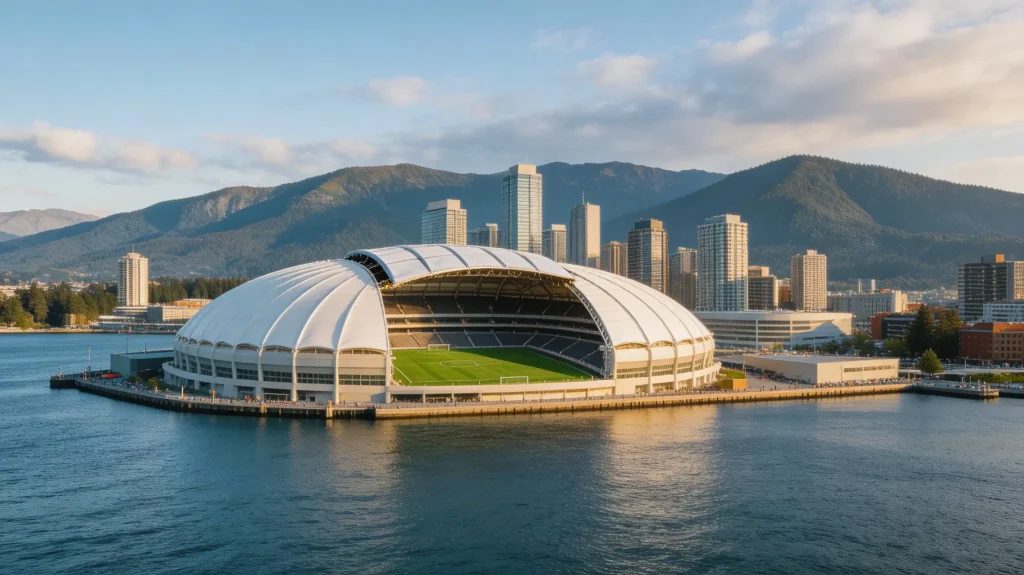
Table of Contents
The Socceroos’ 2026 World Cup begins in a city that feels, in some ways, like a mirror image of Sydney. Vancouver is coastal, multicultural, sports-obsessed and expensive — and on 14 June, it will host Australia versus Turkey at BC Place in a match that could define the entire tournament for Australian punters. I have spent the past six months examining every angle of this fixture, and the venue itself keeps coming back as a factor that most previews ignore. BC Place is not a neutral stage. Its retractable roof, its surface, its location on the Pacific coast and its crowd demographics all tilt the playing conditions in specific directions — directions that matter if you are placing money on the outcome.
About BC Place
BC Place opened in 1983 and underwent a major renovation in 2011, including the installation of a retractable roof that transformed it from an ageing dome into a modern, adaptable venue. The stadium’s capacity for the World Cup is expected to be around 54,000, making it one of the smaller venues in the tournament — but what it lacks in size it compensates for in atmosphere. The retractable roof means that FIFA can control the playing environment: close the roof and the stadium becomes a cauldron of trapped noise and regulated temperature; open it and the Pacific Northwest air flows in, cooling the pitch and creating conditions that favour endurance over explosiveness.
Whether the roof will be open or closed for the Australia-Turkey match depends on weather conditions and FIFA’s operational preferences, but the decision has betting implications. A closed roof traps heat and humidity, which accelerates fatigue — bad news for both sides but particularly for Turkey, whose squad includes several players based in the cooler climates of northern Europe. An open roof in Vancouver’s mild June weather — typically around 18-22 degrees Celsius — creates near-ideal playing conditions with no climate advantage for either team. My expectation is that the roof will be open for the June group stage fixtures, but it is worth monitoring in the days before the match.
The playing surface at BC Place is currently artificial turf for its regular tenants, the Vancouver Whitecaps of MLS and the BC Lions of the CFL. For the World Cup, a temporary natural grass surface will be installed — the same process required at several US venues. FIFA has invested heavily in hybrid grass technology for these installations, but the reality is that a temporary surface at BC Place will not play identically to the permanent pitches at football-specific venues. The ball may sit slightly higher on the grass, the bounce may be marginally less predictable, and players accustomed to pristine training surfaces may notice subtle differences underfoot. For a match between two sides of roughly equal quality, those micro-differences can influence the outcome in ways that the pre-match odds do not capture.
2026 Matches at BC Place
Vancouver is one of two Canadian host cities alongside Toronto, and BC Place will host a share of the thirteen matches allocated to Canada. The exact fixture list for BC Place has not been finalised beyond the confirmed group-stage matches, but the stadium is expected to host four to five games across the group stage, with potential knockout-round allocation depending on the tournament schedule.
The confirmed headline fixture is Australia versus Turkey on 14 June, which kicks off at midnight ET — translating to 14:00 AEST, the most viewer-friendly time slot the Socceroos could have wished for. For Australians watching from home, this is a Saturday afternoon kickoff, perfectly timed for the pub, the lounge room, or the office streaming session that everyone pretends is not happening. The timing also means that the pre-match betting window is generous: punters can assess team news, weather conditions and late market movements throughout the Australian morning before placing their wagers.
Other matches at BC Place will likely include fixtures from Group B (Canada’s group) and potentially neighbouring groups. Canada’s own matches in Vancouver will draw the largest crowds and the most parochial atmosphere, but the Australia-Turkey fixture should also attract significant attendance — Vancouver has large Turkish and Australian diaspora communities, and both will turn up in numbers that create a split-support atmosphere inside the stadium. That divided crowd changes the dynamics compared to a match played in front of a hostile home audience or a disinterested neutral one.
Australia vs Turkey — The Venue Context
Every detail about BC Place feeds into how I model the Australia-Turkey match, and the venue context shifts my assessment in specific ways.
First, the neutral crowd. Neither Australia nor Turkey will have a decisive crowd advantage at BC Place. The Turkish diaspora in Vancouver is present but not dominant, and the Australian community — while enthusiastic — is not large enough to create a wall of green and gold. This neutrality benefits Australia more than Turkey, because Turkey’s European qualification campaign relied heavily on the intensity of their home support in Istanbul, where opponents are physically intimidated before they step onto the pitch. Without that atmosphere, Turkey are a good but beatable side rather than the fearsome proposition they present at home. Australian punters should factor the venue neutrality into their assessment of Turkey’s true away-match quality.
Second, the climate. Vancouver in mid-June is mild, overcast and occasionally drizzly — conditions that suit Australian players who train in similar coastal climates far more than the stereotypes suggest. Sydney, Melbourne and Brisbane all experience comparable temperatures during their cooler months, and the Socceroos’ European-based players are accustomed to training in even cooler conditions at their club sides. Turkey’s squad, by contrast, includes players who spend most of their club season in warmer Mediterranean and Turkish league environments. The mild Vancouver conditions neutralise any climate advantage Turkey might hold at a hotter venue, and they create a physically comfortable ninety minutes where endurance rather than heat management decides the outcome.
Third, the pitch. A temporary grass surface at BC Place introduces a small wildcard. Both Australia and Turkey will have trained on the surface before the match, but neither will have the familiarity that comes from playing on a permanent home pitch. This levels the playing field in a literal sense — the technical precision that distinguishes top teams from mid-ranked sides is slightly less reliable on a surface with unfamiliar bounce and roll characteristics. For Australia, whose game plan relies more on defensive structure and transitions than on intricate passing sequences, the pitch uncertainty is a marginal positive. For Turkey, whose attacking style depends on quick combinations in tight spaces, it is a marginal negative.
Combining these three factors — neutral crowd, mild climate, unfamiliar pitch — I adjust Australia’s implied win probability upward by roughly three to four percentage points compared to a venue-neutral model. That is not enough to make Australia favourites, but it is enough to make the current market odds on a Socceroos win look generous by a meaningful margin.
Vancouver — Travel and Time Zone for Aussies
For the dedicated Socceroos fan making the pilgrimage, Vancouver is one of the more accessible North American cities from Australia. Direct flights from Sydney to Vancouver take approximately fourteen hours, and the Pacific time zone (UTC-7 in June) means a seventeen-hour difference from AEST. That is a brutal jet-lag adjustment — worse than travelling to Europe — and fans arriving within a day or two of the match will be physically compromised in the stands even if their enthusiasm is not.
Vancouver itself is a walkable, safe, visually stunning city that Australian visitors tend to love. The waterfront, Stanley Park, the craft-beer scene in Gastown and the Asian food markets of Richmond feel familiar to anyone from Sydney or Melbourne. Accommodation near BC Place — the stadium sits in the False Creek area, close to downtown — ranges from waterfront hotels to budget hostels in adjacent neighbourhoods. Booking early is essential: Vancouver’s hotel stock is limited compared to larger US cities, and tournament demand will push prices well above normal rates. For punters travelling with a betting budget, keeping accommodation costs manageable is the first act of bankroll discipline before the tournament even begins.
The time zone also affects live betting strategy. Midnight ET kick-off translates to 21:00 Pacific time in Vancouver, which means the match is played in the evening local time — a comfortable slot for players and fans alike. But for Australian punters watching from home at 14:00 AEST, the in-play phone betting window coincides with a time when bookmaker customer service is fully staffed and markets are liquid. This is an advantage: placing in-play bets by phone (the only legal method for live betting in Australia) during a Saturday afternoon is far easier than doing so at 3 a.m. during a midweek fixture. If you are planning a live wager on the Socceroos’ opening match, the timing could not be better.
Insider Take
BC Place is not the grandest venue at the 2026 World Cup, but for Australian punters it is the most important. The Socceroos’ entire group-stage campaign pivots on what happens inside this stadium on 14 June. The venue conditions — neutral crowd, mild climate, temporary pitch — all tilt slightly in Australia’s favour compared to a generic neutral-venue model, and the kick-off time is the best possible slot for the Australian viewing and betting audience.
My approach to the BC Place fixture is simple: I want exposure to an Australian win at odds that reflect the venue advantages the market is underpricing. The draw no bet market on Australia, which removes the draw from the equation, is my preferred entry point. I combine that with a total goals play — over 2.5 goals in a match between two attacking-minded sides playing on an unfamiliar surface where defensive errors are more likely. These two bets capture the scenario I consider most probable: a competitive, open match in which Australia have a realistic chance of starting their 2026 World Cup with a result that changes everything.
