
The World Cup 2026 Bankroll Blueprint — Bet Smarter, Not Bigger
 Available in US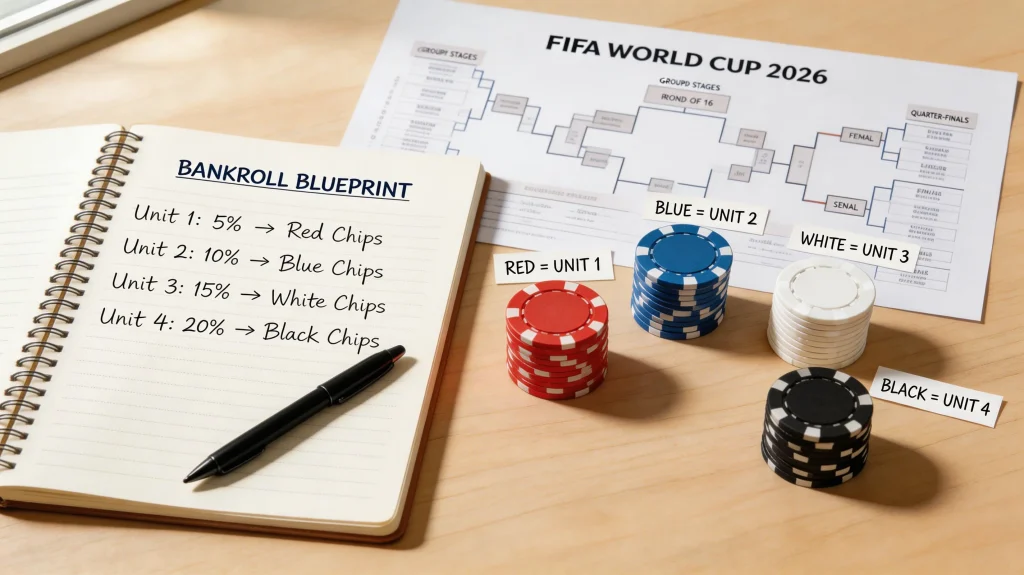
Table of Contents
The 2018 World Cup cost me $1,200. Not because my picks were bad — I actually finished the group stage up $380. I lost it in the knockout rounds, doubling my stakes after every elimination-round winner I backed went out on penalties. By the semi-finals, I was placing $200 bets on matches I had not even analysed properly, chasing the high of those early wins. That tournament taught me the hardest lesson in sports betting: good picks without bankroll discipline are just delayed losses.
The 2026 World Cup runs 39 days. That is 104 matches across three countries, three time zones, and enough betting opportunities to drain even a well-funded account if you do not have a plan. This bankroll blueprint is the system I actually use — not a theoretical framework, but a working model refined across four World Cup cycles. It is not glamorous. It will not make you rich overnight. But it will keep you in the game from the opening match at Estadio Azteca on 11 June all the way to the final at MetLife Stadium on 19 July.
Why Bankroll Discipline Wins More Than Tips
I know punters who have a genuine gift for reading football matches. They spot tactical mismatches, identify undervalued goalscorers, and consistently pick the right side of a World Cup group. They still lose money over the course of a tournament. Every single time. The reason is always the same: they bet too much on the matches they feel most confident about and then have nothing left when the real value opportunities appear later in the competition.
Bankroll management is not the boring administrative cousin of match analysis. It is the structural foundation that determines whether your analysis translates into profit or just ego satisfaction. A punter with average picks and excellent bankroll discipline will outperform a punter with brilliant picks and no discipline over a 39-day tournament — the maths is unambiguous on this point. Variance in a 104-match tournament is enormous. Even if you are right 60% of the time — which would make you one of the sharpest football bettors on the planet — you will still hit losing streaks of four, five, or six bets in a row. The question is whether those streaks wipe out your bankroll or merely dent it.
The core principle is simple: never risk an amount on a single bet that would meaningfully impair your ability to bet on the remaining matches in the tournament. If you blow half your bankroll on a group stage double and it loses, you spend the next 30 days of the World Cup grinding from behind, placing smaller bets on bigger opportunities, watching edges you identified but cannot afford to exploit. That is the real cost of poor bankroll management — not the money you lose, but the opportunities you miss.
There is a psychological dimension here too. When your bankroll is healthy, you make calm, analytical decisions. When it is depleted, you chase. You increase stakes to recover losses. You add legs to multis to inflate the potential return. You back teams you have not researched because the odds “look good.” Every one of these behaviours is a bankroll management failure disguised as a betting decision.
Unit Sizing for a 39-Day Tournament
Before the 2022 World Cup, I sat down and calculated exactly how many bets I expected to place across the entire tournament. Group stage: roughly two to three bets per matchday, across 12 matchdays. Round of 16: one to two bets per day across four days. Quarter-finals through the final: one bet per match. The total came to approximately 45-55 individual wagers over four weeks. That number shaped my entire staking plan.
The unit system is straightforward. Your total World Cup bankroll — the amount you have set aside specifically for the tournament, money you can afford to lose entirely without affecting your life — gets divided into units. I use a 100-unit system, which means each unit is 1% of my total bankroll. If your World Cup bankroll is $2,000, one unit is $20. If it is $500, one unit is $5. The dollar amount does not matter. What matters is that every bet you place throughout the tournament is sized in units, not dollars, and you never exceed your allocation for a single bet.
My standard bet size is 1 unit. For bets where I have higher conviction — a strong analytical edge, a clear market mispricing, or a spot where my model diverges significantly from the bookmaker’s line — I go to 2 units. I never exceed 3 units on a single wager, and 3-unit bets happen maybe two or three times across an entire tournament. The discipline is in the ceiling, not the floor. You can always bet less than 1 unit on a speculative play, but you must never talk yourself into a 5-unit bet because you “just know” Germany are going to smash Curaçao.
For multi bets, I count the multi as a single wager and size it accordingly — 1 unit for a standard multi, 0.5 units for a speculative long-shot multi. The temptation with multis is to think “it is only $10” and fire off three or four per matchday. Four $10 multis per day across 12 group stage matchdays is $480 — nearly a quarter of a $2,000 bankroll — and multi strike rates are low enough that most of that money vanishes. Track your multis in units, not feelings.
The 2026 tournament is longer and larger than any previous World Cup. With 104 matches, you might identify 60 to 80 betting opportunities that pass your quality filter. A 100-unit bankroll gives you the ammunition to bet selectively across all 39 days without ever needing to increase your stakes to compensate for early losses.
Group Stage vs Knockouts — Adjusting Your Stakes
Matchday three of the 2022 group stage — the final round of group matches — produced some of the wildest results in World Cup history. Japan beat Spain to top Group E. Australia smashed Denmark 1-0 to qualify from Group D. Cameroon beat Brazil. I had already used 40% of my bankroll by that point, and I was furious with myself because matchday three was where the best value appeared. Teams fighting for survival, dead rubbers being treated like friendlies, managers resting key players — the information asymmetry on the final group matchday is enormous, and I did not have enough firepower to exploit it.
Since then, I have split my bankroll into two phases. Phase one covers the group stage — all 48 group matches across the three matchdays. I allocate 55% of my total bankroll to this phase. Phase two covers the entire knockout stage, from the Round of 32 through the final — 56 matches in total. That gets 45% of my bankroll. The split is not even because the group stage offers more individual betting opportunities with wider margins in the odds, while the knockout stage offers fewer but higher-conviction bets.
Within phase one, I further allocate by matchday. Matchday one — where teams are cautious and managers are conservative — gets 30% of the group stage allocation. Matchday two gets 30%. Matchday three, where the chaos peaks and the value explodes, gets the remaining 40%. This back-loading means I always have my largest allocation for the phase of the group stage where my analysis is strongest, because by matchday three I have watched every team play at least once and the odds have not yet fully adjusted to in-tournament form.
The knockout stage requires a fundamentally different mindset. Every match is a standalone event with elimination stakes. Upsets are more common because inferior teams can park the bus, survive to extra time, and win on penalties. I reduce my average bet size in the knockouts from 1 unit to 0.75 units for standard bets, and I am far more selective about which matches I bet on at all. In the 2022 knockouts, I placed bets on 11 of 16 matches. In 2026, with a Round of 32 that adds another 16 matches, I expect to be even more selective — perhaps betting on 15 of the 56 knockout fixtures. Selectivity is the knockout round superpower.
The Credit Card Ban — What It Means for Your Strategy
Since June 2024, Australians can no longer use credit cards to fund online betting accounts. This regulation, which was years in the making, fundamentally changes how you should think about your World Cup bankroll — and, in my view, it is one of the best things to happen to Australian punters in a decade.
Before the ban, the temptation to reload a depleted betting account with a credit card was real and devastating. I have spoken to punters who racked up thousands in credit card debt during the 2022 World Cup, chasing losses with borrowed money. The credit card ban eliminates that trap entirely. If your debit account is empty, you stop betting. Full stop. That enforced boundary is more effective than any self-imposed staking rule, because it operates at the infrastructure level rather than the willpower level.
Practically, the credit card ban means you need to front-load your bankroll before the tournament starts. Deposit your total World Cup allocation into your betting account (or split across multiple accounts if you use several bookmakers) before 11 June. Do not plan to top up during the tournament — treat your deposited amount as the ceiling. If you run through your bankroll by the quarter-finals, the tournament is over for you as a bettor. You can still enjoy the football.
This also means your initial bankroll calculation matters more than ever. Be honest about what you can afford. The 39-day duration of the 2026 World Cup creates a marathon, not a sprint, and the worst strategic error is setting a bankroll that is too small for the number of bets you want to place. If you want to bet on 50 matches across the tournament, a $200 bankroll gives you $4 per bet. That is workable, but only if you accept that individual bet sizes will be small. A $1,000 bankroll gives you $20 per unit — more comfortable for most punters, and enough to make meaningful returns on strong picks without overextending.
My Personal Staking Plan for 2026
I am sharing the exact plan I intend to use for the 2026 World Cup. Not a theoretical model — this is my real allocation, refined from the mistakes of four previous tournaments.
My total bankroll for the 2026 World Cup is set. I will not disclose the dollar figure because it is irrelevant — what matters is the structure. I divide it into 100 units. Group stage gets 55 units. Knockout stage gets 45 units. Within the group stage, matchday one gets 16 units, matchday two gets 16 units, and matchday three gets 23 units. Within the knockouts, Round of 32 gets 15 units, quarter-finals get 12 units, semi-finals get 10 units, and the final gets 8 units.
My bet sizing: 1 unit standard, 2 units for high conviction, 0.5 units for speculative plays and multis. Maximum three multi bets per matchday during the group stage, two per matchday during the knockouts. No multi exceeds 0.5 units. Every bet is logged in a spreadsheet before I place it — the act of writing down the bet, the odds, and my reasoning forces me to justify the wager to myself, and I reject roughly 30% of bets at this stage because the reasoning does not hold up when I have to articulate it.
The hardest part of this plan is not the structure — it is the execution. There will be a day during the group stage where I lose three bets in a row and the temptation to double my next stake will be overwhelming. There will be a knockout match where I am certain the underdog will win and I want to throw 5 units at it. In both cases, the plan says no, and I follow the plan. That is the entire point. The plan exists to override the emotional impulses that tournament football — with its drama, its deadlines, and its atmosphere — inevitably creates.
If you take one thing from this blueprint, make it this: decide your total bankroll and your unit size before the tournament starts, write it down, and do not change it. The 2026 World Cup betting guide can sharpen your picks, but this bankroll structure is what keeps you alive long enough for those picks to matter. The punters who are still betting with clear heads in the semi-finals are the ones who had a plan from day one. Be one of them.
