
World Cup Betting Types Most Aussies Overlook
 Available in US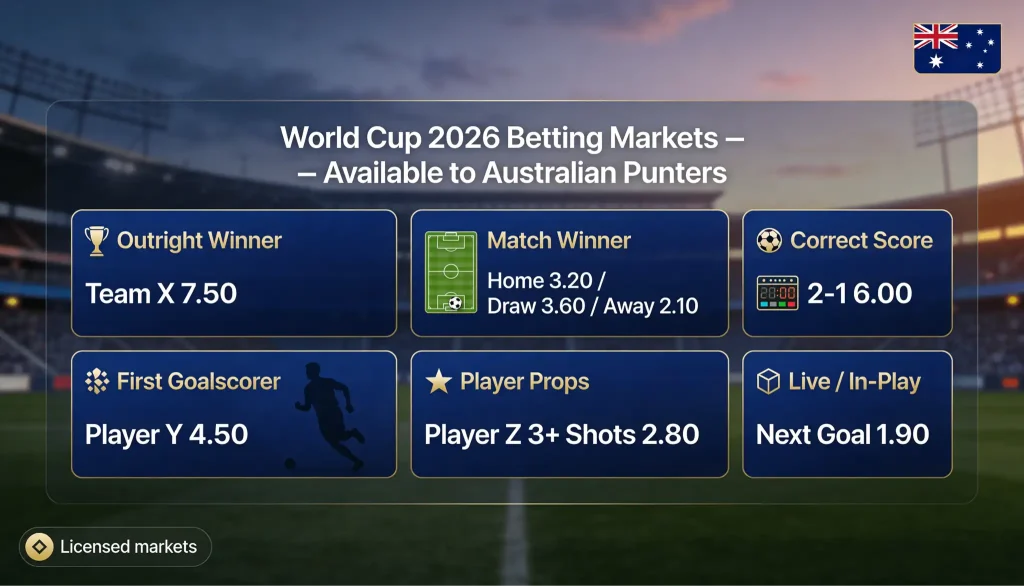
Table of Contents
I watched a mate drop $400 on a five-leg multi during the 2022 World Cup. Four legs landed. The fifth — Argentina to win to nil against Saudi Arabia — died in the 48th minute. He spent the next three weeks placing the same kind of multi, tweaking one leg each time, bleeding money on a market designed to keep him coming back. That experience taught me more about market selection than any textbook ever could. The bookmakers in Australia offer dozens of World Cup betting types, but most punters only touch two or three of them. The rest sit there, quietly offering better edges, while the crowd chases the same head-to-head and outright bets they have always chased.
This is not about listing every market on a sportsbook menu. I have spent eight years analysing international tournament betting, and I want to walk you through the World Cup betting types that actually reward careful thinking — the ones that give you leverage the bookmakers would prefer you never discovered. If you have been punting the World Cup the same way since 2018, this is the piece that changes your approach.
Outrights and Futures — The Long Game
A colleague once told me that outright markets are where bookmakers make their easiest money. He was half right. Most punters place an outright bet on their favourite team in January and forget about it. That is not a strategy — that is a donation. But outrights, when used properly, are the single most powerful market in a World Cup cycle.
An outright bet — also called a futures bet — is a wager on the tournament winner. At the 2026 World Cup, with 48 teams competing, the outright market is wider than ever. Spain sit around 5.50 in decimal odds as favourites. England hover near 6.50. But the real value in outrights is not at the top of the market. It is in the 15.00 to 35.00 range, where teams like the Netherlands, Portugal, and Colombia sit — sides with genuine knockout-stage quality that the public consistently underestimates because they are not named France or Brazil.
The key to outright betting is timing. Odds shift dramatically after the group stage draw, after friendlies, and especially after the first round of group matches. I placed an outright on Argentina at 11.00 before the 2022 tournament and watched those odds collapse to 4.50 by the quarter-finals. The edge was in moving early, not late. For the 2026 cycle, the window between now and the opening match on 11 June is your best opportunity. Once the ball rolls at Estadio Azteca, the market tightens fast.
Each-way outrights deserve a separate mention. Some Australian bookmakers offer each-way terms on the World Cup winner — typically paying out at reduced odds if your team reaches the final or semi-finals. On a 25.00 outright, an each-way at quarter odds pays 6.25 if your team makes the final. That is a built-in safety net most punters ignore completely. With a 48-team tournament producing more matches and more upsets, each-way outrights on mid-tier contenders look better than they have at any previous World Cup.
One last point on outrights: do not put all your outright allocation on a single team. I typically spread across three selections — one short-priced favourite, one mid-range contender, and one genuine outsider. The maths works in your favour when you diversify. A $50 outright on a 25.00 shot returns $1,250. You do not need it to win every time.
Match Markets: Head-to-Head, Draw No Bet, Asian Handicaps
Here is a question that separates casual punters from serious ones: when was the last time you placed a Draw No Bet on a World Cup group match? If you have never heard of it, you are leaving money on the table every single matchday.
The standard match market — 1X2, or head-to-head with the draw — is where most Australians start and finish. You pick a winner or the draw, and the three-way market splits the probability. In group stage matches at the 2022 World Cup, 16 of 48 games ended in a draw. That is a 33% draw rate, which means one in three head-to-head bets on a team to win faces a roughly one-in-three chance of a void result. The house loves this market because the draw option inflates the overround.
Draw No Bet removes the draw from the equation entirely. You back a team to win, and if the match draws, your stake is refunded. The odds are lower — backing Brazil to beat Scotland might pay 1.45 on the 1X2 but only 1.25 on Draw No Bet — but your risk profile changes dramatically. In a tournament where group stage draws are common and upsets frequent, Draw No Bet is a defensive tool that protects your bankroll during the chaotic opening rounds.
Asian Handicaps take this a step further. Instead of removing the draw, they apply a goal handicap to one team. If you back Australia at +0.5 on the Asian Handicap against the USA, you win if Australia draws or wins — it is functionally the same as Draw No Bet, but the odds are often slightly better because the market is more liquid. Asian Handicap +1.0 means your team can lose by one goal and you still get your stake back. For a Socceroos side that might grind out tight results against Paraguay or Turkey, a +1.0 Asian Handicap on their group matches offers genuine protection without sacrificing all your upside.
The deeper Asian Handicap lines — 0.0/0.5 splits, -1.5, +1.5 — are where experienced punters find real edges. A -1.5 handicap on Spain against Cape Verde in Group H might pay 1.70, reflecting the market’s view that Spain wins by two or more goals roughly 59% of the time. If your own analysis says that figure should be closer to 65%, you have found value. That kind of granular assessment is impossible on a standard 1X2 market where the draw muddies the calculation.
My rule for group stage match betting: use 1X2 only when you have strong conviction on a specific result, including draws. For everything else, default to Draw No Bet or Asian Handicaps. Your variance drops, your bankroll lasts longer, and you make better decisions because you are asking a simpler question — who is the better team?
Multis — The Aussie Favourite and How to Use Them Wisely
Australians love multis the way Brazilians love samba — instinctively, passionately, and sometimes to their own detriment. During the 2022 World Cup, multi bets accounted for a staggering share of total turnover at major Australian bookmakers. The appeal is obvious: small stakes, massive potential returns. A $10 four-leg multi at combined odds of 15.00 pays $150. It feels like free money until you realise that the probability of landing all four legs drops exponentially with each addition.
I am not here to tell you to stop placing multis. I place them myself. But I have rules, and they have saved me thousands over the years.
First, cap your multi at three legs for group stage matches. Every additional leg roughly halves your probability of winning the entire bet. A three-leg multi gives you a realistic chance of landing. A six-leg multi is a lottery ticket — fun, but not a strategy. During the knockout rounds, I drop to two legs maximum because the matches are tighter and harder to predict.
Second, never build a multi entirely from 1X2 markets. Mix your markets. Combine a Draw No Bet leg with an over/under goals leg and a team to qualify leg. This diversification means one dodgy result does not automatically kill your entire bet. If you have three 1X2 legs and one match draws, you lose everything. If one of those legs was Draw No Bet, the draw just voids that leg and your multi recalculates at reduced odds.
Third — and this is the one most punters miss — calculate the implied probability of your multi before placing it. A four-leg multi at combined odds of 12.00 implies an 8.3% chance of winning. Ask yourself honestly: do I believe there is a better than 8.3% chance all four of these outcomes happen? If the answer is no, reduce your legs or change your selections. If the answer is yes and you can articulate why, you have found a value multi.
The 2026 World Cup, with its expanded 48-team format and 104 matches over 39 days, is a multi playground. More matches means more opportunities, but also more traps. Group E, for instance, features Germany against Côte d’Ivoire, Ecuador, and Curaçao — three matches where Germany should be favoured but where the margins might be slimmer than the odds suggest. Building a multi around “safe” group-stage favourites is precisely the trap the bookmakers set. The groups with genuine mismatches — Group H with Spain, Group J with Argentina — are where your multi legs should come from, because the probability of the favourite winning is genuinely higher there.
Props, Player Bets and Tournament Specials
Two years ago, I backed Kylian Mbappé to score in every France group match at a combined price of around 8.00. He scored in two of three. I lost. But the logic was sound — Mbappé’s minutes-per-goal ratio in competitive internationals was elite, France’s group opponents were manageable, and the odds reflected public money flowing toward Harry Kane and Lionel Messi instead. Prop markets — also called specials or exotics — are where the bookmaker’s models are weakest, and where an analyst with a specific opinion can find edges the main markets do not offer.
Player props for the World Cup include anytime goalscorer bets (will a specific player score in a specific match), first goalscorer bets (higher odds, higher variance), and tournament-long player totals (over/under 2.5 goals for a named player across the whole event). The first goalscorer market carries a massive house edge — typically 30% or more overround — so I avoid it entirely. Anytime goalscorer is more efficient, usually running at 10-15% overround, and the pricing on lesser-known forwards is often softer than on the marquee names.
Tournament specials are the wild west of World Cup betting types. These include markets like: which group produces the most goals, will there be a red card in the final, will any team win all their group matches without conceding, and the increasingly popular “specials multis” that bookmakers pre-package. The pre-packaged specials are almost always bad value — the bookmaker has already built in a hefty margin. But the individual tournament markets can be gold. At the 2022 World Cup, the over/under on total tournament goals was set at 163.5 by most bookmakers. The actual total was 172. A 48-team tournament with 104 matches will push that number well above 200, and the early over/under lines I have seen suggest the market is still adjusting to the sheer volume of games.
My favourite prop market for any World Cup is “team to keep a clean sheet” on a per-match basis. This market often misprices defensive sides — teams like Morocco, who built their 2022 run on an elite backline, or Turkey, whose defensive structure under their current setup is better than their odds suggest. When a team’s defensive quality is underrated by the public, the clean sheet price on their matches offers value the main market does not capture.
Corner and card markets have grown in sophistication over recent cycles. Total match corners, total match bookings, and even player-specific card markets are now available at most licensed Australian operators. These markets are driven by data rather than public sentiment, which means the pricing is sharper — but it also means that punters with genuine tactical knowledge of how teams play can find discrepancies. A team that presses aggressively and forces corners will consistently beat the corner line if the bookmaker has underestimated their pressing intensity. That kind of edge does not exist in the head-to-head market.
In-Play Betting — Australia’s Phone-Only Rule
If you have ever tried to place a live bet on a World Cup match through your bookmaker’s app and hit a wall, you have run into one of Australia’s most distinctive gambling regulations. Under the Interactive Gambling Act 2001, in-play betting — placing a bet after the match has started — is banned online in Australia. You can only place live bets by calling your bookmaker’s phone line. It sounds archaic, and frankly, it is. But it is the law, and it creates a unique dynamic for Australian punters during the World Cup.
The phone-only rule means that in-play betting in Australia is slower, more deliberate, and less impulsive than in jurisdictions where you can tap a button on your phone mid-match. That is actually an advantage if you use it correctly. The few seconds it takes to dial, explain your bet, and confirm forces you to think about whether you really want the wager. Impulsive live betting — chasing a goal, panicking after a red card — is one of the fastest ways to destroy a bankroll during a 39-day tournament. The phone barrier slows you down.
That said, the practical reality is that most Australians do not bother with in-play betting because the phone process feels cumbersome. This means the in-play market is thinner on the Australian side, and the operators who do offer it by phone are pricing it with wider margins than their international counterparts. My advice: use in-play betting sparingly and strategically. The best in-play opportunities at a World Cup come when a heavy favourite concedes first in a group match — the live odds on that favourite spike, often overcorrecting, and a calm phone call can lock in value that did not exist pre-match.
For the 2026 World Cup specifically, the time zone challenge complicates in-play betting further. Many matches will kick off at times that translate to early morning or late night in Australia — 5:00 AM AEST for a 3:00 PM ET kickoff, for example. Calling a phone line at 5:30 AM to place a live bet requires dedication. If you are committed to in-play punting during the tournament, plan your matches in advance. Identify the two or three fixtures per matchday where you see the highest probability of an in-play opportunity, set an alarm, and have your bookmaker’s phone number saved. Do not try to live-bet every match — you will burn out before the knockout rounds begin.
Insider Pick: Best Market for Each Round
After eight tournaments’ worth of data and personal experience, I have developed a framework for which World Cup betting types work best at each stage of the competition. This is not theory — it is the playbook I actually follow with my own bankroll.
During the group stage, the best market is Asian Handicap. Group matches produce the widest range of outcomes — blowouts, draws, upsets — and the Asian Handicap lets you bet on margins rather than binary results. When France face Iraq in Group I, the question is not whether France win — it is by how many. The -1.5 or -2.0 Asian Handicap on France gives you a specific, testable hypothesis: will France win by two or more? That kind of precision is where edges live.
For the Round of 32, switch to Draw No Bet. The first knockout round at a 48-team World Cup will feature several mismatches — group winners against third-placed qualifiers — but knockout football always carries the risk of extra time and penalties. Draw No Bet protects you against the 1-1 that goes to spot kicks. Your team might still be eliminated, but your bet survives the draw. In a round with 16 matches over four days, Draw No Bet lets you back multiple favourites without the variance of outright 1X2.
Quarter-finals and semi-finals are where I shift to team props and tournament specials. By this stage, you know the teams intimately — their form, their injury lists, their tactical tendencies through six or seven matches. The main match markets are sharply priced because the bookmakers have the same information. But the peripheral markets — clean sheet, total goals over/under, first half result — are priced off models that may not fully account for how a specific matchup plays out tactically. A quarter-final between two defensive sides might see the total goals line set at 2.5 when the match profile screams under 2.0. That gap is your edge.
For the final itself, I avoid the match market entirely. The World Cup Final is the single most heavily bet football match on the planet, which means the main market is as efficient as it gets. There is no edge in 1X2 on the final. Instead, I look at method of victory — will the match be decided in regular time, extra time, or penalties? Historical data shows that five of the last ten World Cup Finals have gone to extra time or penalties. The “not decided in regular time” market typically pays around 3.00, which implies a 33% probability. The actual historical rate is 50%. That is a massive discrepancy, and it persists because the public overwhelmingly bets on a team to win in 90 minutes.
The 2026 World Cup runs 39 days with 104 matches. That is not a sprint — it is a campaign. Matching the right World Cup betting strategy to each phase of the tournament is the difference between punters who survive to the final and those who tap out after the group stage. Choose your markets deliberately, and the tournament rewards you.
